

AI and Expert Reports Victoria and NSW 2026
1. Introduction
On the 4th June 2026, the Australian Academy of Forensic Sciences, Victorian Chapter, convened a meeting to host the presentation - AI, Forensic Science and the Law: Balancing Opportunities and Risks. The presenters were: LRC Commissioner, Anthony North KC, Kaye Ballantyne, Chief Forensic Scientist, Victoria Police Forensic Services Department.
The Australian justice system is currently navigating a pivotal era defined by the rapid expansion of artificial intelligence (AI) into the forensic and legal domains. The 2026 landscape marks the end of the theoretical AI debate and the beginning of mandatory procedural compliance. As articulated in the Victorian Law Reform Commission’s (VLRC) 2026 report—which features 30 specific recommendations for institutional adaptation—the strategic challenge lies in balancing "safe use" with the immense technological opportunities AI presents. We must integrate AI to enhance court efficiency and access to justice, yet this integration requires a sophisticated architecture that distinguishes where technology ends and human accountability begins.
To understand the scale of this integration, one must consider an incident scenario and the potential application of AI. In an incident, AI has the potential to touch every facet of the evidence chain.
AI Touchpoints in Criminal Investigation can be:
CCTV Analysis: Sifting through thousands of hours of footage to identify specific vehicle models or suspects.
Fingerprint Processing: Using algorithms to triage latent prints found on recovered firearms or scene surfaces.
DNA Interpretation: Utilising mathematical programs to resolve complex biological mixtures.
Digital Forensics: Managing the high volume of data extracted from mobile devices and social media.
Physical Aretefacts: Automating the comparison of artefacts.
In the investigation context, AI must be viewed as a tool for augmentation and triaging, not a replacement for human intellect. It is critical to distinguish between "built" systems—where details are designed by humans—and "cultivated" systems. Cultivated systems are a significant legal liability because the intelligence "grows" within a framework, often leaving the internal computational representations unknown even to the developers themselves, making them effectively unauditable.
2. Jurisdictional Analysis: Victoria vs. New South Wales
Forensic and legal experts must now navigate a fragmented regulatory environment. There is a sharp strategic tension between Victoria’s "principle-based" approach, which seeks to integrate AI through disclosure and transparency, and the more restrictive "leave-based" regime adopted by New South Wales (NSW).
The Victorian framework, governed by the VLRC’s 2026 report and the May 14 2024, Practice Note, permits AI use provided there is meaningful human control and full disclosure. Conversely, NSW has adopted a "restriction-by-default" model that requires explicit judicial permission for AI involvement in key legal documents.
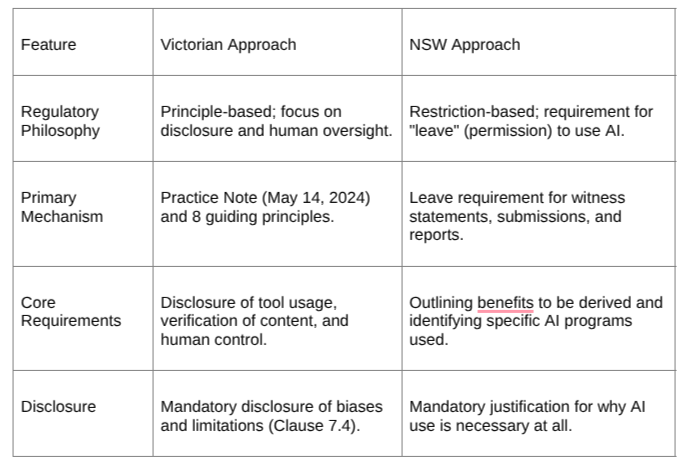
The impact of Section 79 of the Evidence Act is central to this analysis. This section requires that expert opinion be based on "specialised knowledge" derived from training, study, or experience. The Cosette Dispute Handbag Case (NCAT) serves as a vital precedent: the court rejected an AI-generated report regarding a counterfeit handbag because the internal "knowledge" of the AI could not be verified. Without a human expert who could testify to the underlying specialised knowledge, the evidence was found to be legally hollow.
3. Ethical Foundations: The "Babel Syndrome" and Human Dignity
The ethical gravity of AI in the justice system requires that strategic policy be anchored in the "Common Good." The "Technocratic Paradigm" threatens the principle of subsidiarity by concentrating power in the hands of private, transnational actors. Opaque algorithms create a "Black Box" that erodes accountability.
4. Technical Considerations: Validation, Reliability, and Error Rates
The forensic expert acts as a technical gatekeeper. In an era where AI developers may release 17 different models in 2 years, the traditional two-year validation cycle for DNA kits is no longer the benchmark. Strategy must shift from protecting proprietary "Black Box" secrets to proving transparent error rates.
A crucial distinction must be maintained between Investigative Triaging (e.g., filtering CCTV) and Evidentiary Analysis (e.g., facial comparison). However, the highest level of reliability is found in the AI-Human Conclave. For example, while facial comparison algorithms can reach 99.97% accuracy, they make different mistakes than human examiners. Combining the two offers a strategic opportunity to reach near-perfection.
Technical "Red Flags" in Forensic AI:
Training Data Bias: Systems trained on biased data sources.
The Validation Gap: To avoid "just-so stories" (post-hoc reasoning), real-world testing is mandatory. AI experts must conduct field tests to determine the actual false positive/negative rates.
5. Verification and Presentation in Expert Reports
The expert’s primary duty is to the court, as per the Victorian Practice Note. "Meaningful human control" is the only safeguard against AI "hallucinations."
Expert Report Mandatory Disclosure Checklist:
Disclosure of AI Usage: Explicitly state if and how AI tools were used.
Verification of Content: Affirm human verification of all AI-generated output.
Scientific Validity: Demonstrate repeatable, reproducible, and accurate results.
Bias and Limitations: Disclose known training biases or reliability limits.
Exercise of Particular Caution: Affirm compliance with mandatory caution requirements.
To resolve complex disputes, the judiciary increasingly utilises "Hot Tub" evidence (expert conclaves) to find common ground on technological reliability.
References
The Australian Academy of Forensic Sciences, Victorian Chapter meeting June 4th 2026 - AI, Forensic Science and the Law: Balancing Opportunities and Risks. The presenters were: LRC Commissioner, Anthony North KC Kaye Ballantyne, Chief Forensic Scientist, Victoria Police Forensic Services Department.
Encyclical Letter of His Holiness Leo XIV Magnifica Humanitas (15 May 2026)
SC GEN 25 - The use of Artificial Intelligence by Court users | The Supreme Court of Victoria - https://www.supremecourt.vic.gov.au/areas/legal-resources/practice-notes/sc-gen-25-the-use-of-artificial-intelligence-by-court-users
VLRC_AI_in_Victorias_Courts_and_Tribunals_Report.pdf - https://www.lawreform.vic.gov.au/publication/artificial-intelligence-in-victorias-courts-and-tribunals-report/